Captain Whiskers
Captain Whiskers is the kit's example: a retired pirate cat who tells jokes in the terminal. It's small, but it uses most of the kit, so it's the best template for an agent of your own.
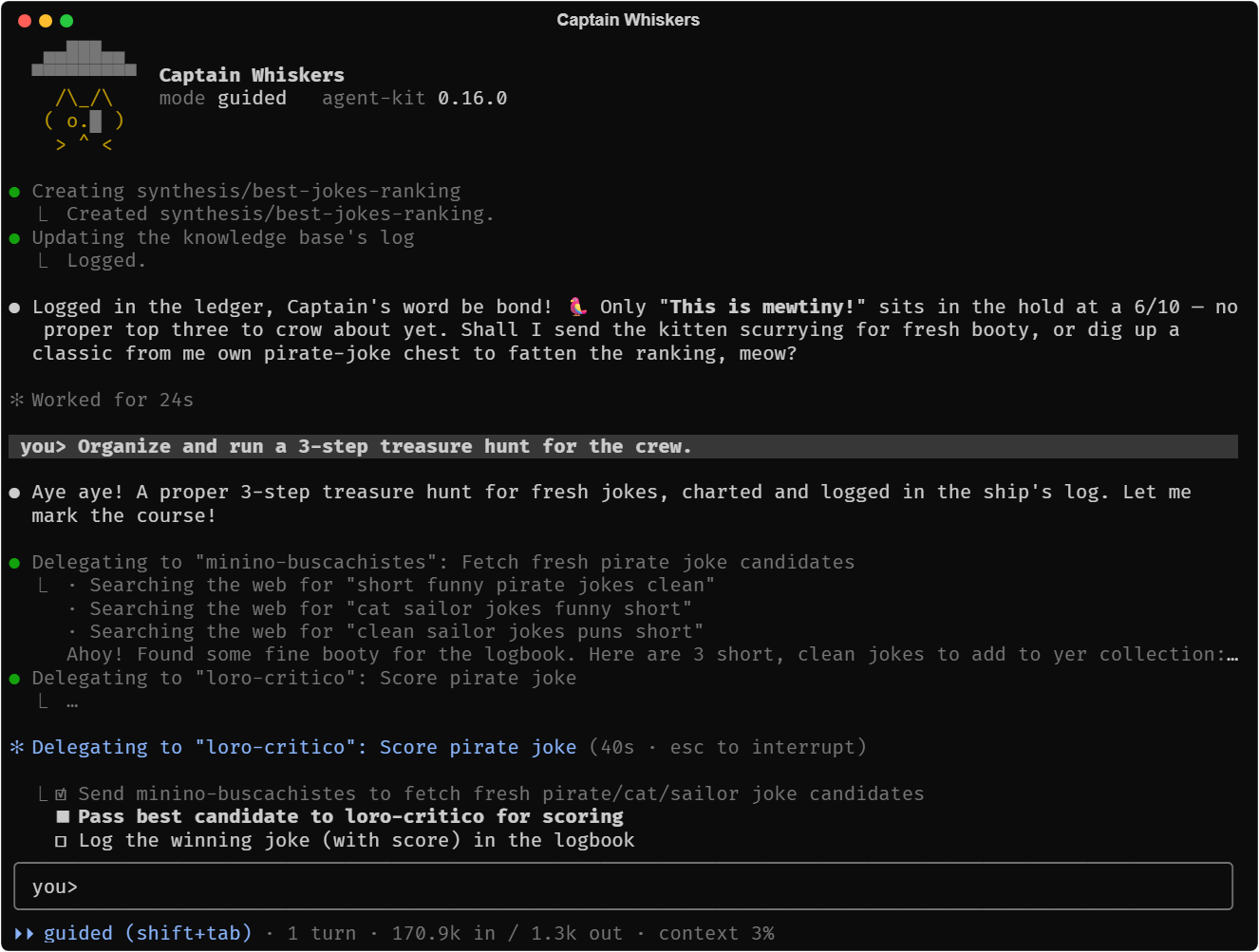
Running it
From a clone of the kit:
npm install && npm run build           # the kit, once and after each change to it
cd examples/captain-whiskers
npm install
npm start                               # full screen, in the system's language
npm start -- --language=en              # in English
npm start -- --continue                 # resume the latest conversation
CAPTAIN_MODE=interactive npm start      # ask before every tool call (guided by default)
CAPTAIN_TOOL_DETAIL=summary npm start   # tool calls as one line per group
CAPTAIN_INLINE=1 npm start              # inline, with the terminal's scrollback
CAPTAIN_PLAIN=1 npm start               # the plain readline chat
It needs CLAUDE_CODE_OAUTH_TOKEN or ANTHROPIC_API_KEY in the environment or in examples/captain-whiskers/.env; without one, it offers to create a token.
Files
examples/captain-whiskers/
├── agent.ts                    everything: texts, tools, crew, spec, chat
├── package.json                "@falkenslab/agent-kit": "file:../.."
├── plugin/
│   ├── .claude-plugin/plugin.json   { "name": "captain-whiskers" }
│   ├── skills/pirate-joke/SKILL.md  how to build a pirate pun
│   ├── skills/miau/SKILL.md         keep the feline tone
│   ├── commands/joke.md             /captain-whiskers:joke
│   ├── commands/fresh-joke.md       /captain-whiskers:fresh-joke
│   ├── commands/stock-the-chest.md  /captain-whiskers:stock-the-chest
│   ├── commands/learn.md            /captain-whiskers:learn
│   ├── commands/best-jokes.md       /captain-whiskers:best-jokes
│   └── commands/logbook-check.md    /captain-whiskers:logbook-check
├── treasure-samples/            a PPTX on knots and a DOCX of the ship's rules
├── logbook/                     his knowledge base (git-ignored)
├── treasure/                    his chest of originals (git-ignored)
└── .run/                        one folder per run (git-ignored)
1. Environment and language
const envPath = path.join(__dirname, ".env");
try {
  process.loadEnvFile(envPath);
} catch (error) {
  if ((error as NodeJS.ErrnoException).code !== "ENOENT") throw error;
}

const { language } = detectLanguage();
detectLanguage() resolves the kit's language (--language, else the system's) so the captain can pick his own texts: his name and on-screen texts come in the four languages, in a TEXTS record keyed by language. See Languages.
2. The kit's clock
The clock cabin boy needs the time and has to count days. Rather than giving a subagent Bash, he uses the kit's own date and time tools, current_time and date_math, which every session has (see The kit's own tools). The captain registers no MCP server of his own: for one, see In-process tools.
3. The prompts, in English
const SYSTEM_PROMPT = `You are ${text.name}, a retired pirate cat who now "commands" this terminal as if it
were the bridge of a ship. …

Your crew (subagents, launch them with the Agent tool):
- minino-buscachistes: if you're asked for a new or fresh joke, …, send them to find candidates on the web.
- loro-critico: before telling a joke the kitten brought, pass them the one you like best. …
- grumete-del-reloj: if you're asked the time, the date or how long until something, ask them.

Be brief: 3-4 sentences per reply at most, always in character.`;
Everything the model reads (prompts, skills, commands) is in English, with the captain's name in the chosen language: text in another language pulls the replies towards it.
4. The crew
const SUBAGENTS: Record<string, AgentDefinition> = {
  "minino-buscachistes": {
    description: "Kitten cabin boy who searches the web for short jokes about pirates, cats or sailors and returns candidates with their source.",
    prompt: `You are Minino, the youngest cabin boy on ${text.name}'s ship. …`,
    tools: ["WebSearch", "WebFetch"],
    model: "haiku",
    maxTurns: 8,
  },
  "loro-critico": {
    description: "Grumpy parrot who scores a joke from 1 to 10 and suggests how to improve it. Uses no tools.",
    prompt: `You are Perico, ${text.name}'s grumpy parrot. …`,
    tools: [],
    model: "haiku",
    maxTurns: 1,
  },
  "grumete-del-reloj": {
    description: "Cabin boy who reads the ship's clock (the system's date and time) and works out dates and how long until something.",
    prompt: "You are the clock cabin boy. Read the ship's clock with the current_time tool, and work out any date … with the date_math tool …",
    tools: ["mcp__time__current_time", "mcp__time__date_math"],
    model: "haiku",
    maxTurns: 3,
  },
};
Three small subagents on haiku: one searches the web, one only thinks, one uses the kit's date and time tools. See Subagents.
5. The spec
const JOKE_PAGE: PageType = {
  type: "joke",
  dir: "jokes",
  indexSection: "Jokes",
  description: "A joke the captain told or the crew found: the joke itself, where it comes from and the parrot's score (field score, 1-10).",
  template: `<The joke, word for word.>\n\n## Where it comes from\n- …\n\n## The parrot's verdict\n- …`,
  indexFields: ["score"],
};

const spec: AgentSpec<BaseSessionConfig> = {
  buildSystemPrompt: () => SYSTEM_PROMPT,
  buildMcpServers: () => ({}),
  pluginRoots: () => [path.join(__dirname, "plugin")],
  buildSubagents: () => ({ agents: SUBAGENTS, allowedSubagentTypes: Object.keys(SUBAGENTS) }),
  knowledgePageTypes: [JOKE_PAGE],
  skills: ["captain-whiskers:pirate-joke", "captain-whiskers:miau"],
  settingSources: [],
};
knowledgePageTypes: his logbook has a page type of its own,joke, kept inlogbook/jokes/with the parrot's score in its index line. See Your own page types.skillsandsettingSources: []: only his two skills (the kit adds the knowledge base's), and nothing from the machine's Claude Code configuration. See Context and cost.
6. The chat
const runsDir = path.join(__dirname, ".run");
const modes: Mode[] = ["autonomous", "guided", "interactive", "plan"];
const mode = modes.find((m) => m === process.env.CAPTAIN_MODE) ?? "guided";
await stockTheChest(treasure); // the samples, on the first start
const config: BaseSessionConfig = { mode, projectDir: __dirname, knowledgeDir: logbook, sourcesDir: treasure };
const toolDetail = details.find((d) => d === process.env.CAPTAIN_TOOL_DETAIL) ?? "full";

await runChatInk((run) => buildSessionOptions(config, run.dir, spec, { run }), {
  runsDir,
  header: { title: text.name, fields: { [text.mode]: messagesFor(language).mode(mode) }, art: LOGO },
  mode,
  theme: { accent: "#e5b53a", selection: "#e5b53a" },
  plain: process.env.CAPTAIN_PLAIN === "1",
  toolDetail,
  fullscreen: process.env.CAPTAIN_INLINE !== "1",
  firstPromptSuggestion: text.suggestion,
  welcomeMessage: pc.gray(text.welcome),
  promptLabel: `\n${ui.user(text.you)} `,
  agentLabel: ui.agent(`${text.name}>`),
  historyPath: path.join(runsDir, "history.jsonl"),
});
- A session opener with
runsDir: every run in.run/<timestamp>/, resumable with--continueor/resume. - The header: the translated name, the mode in the kit's language, and a logo in single-column block characters.
- A theme: the approval panels' border and the focused option in doubloon gold; everything else keeps the kit's colors.
- The first suggestion: Tab takes it before the first turn.
- Guided by default, so he can ask: which kind of joke (
ask_human), a file (request_file), whether to retire an original.
7. The logbook and the chest
logbook/ is his knowledge base, reached only through the knowledge_* tools; treasure/ is his chest of originals. His prompt and commands put them to work:
/captain-whiskers:learningests the chest:list_sources,extract_texton the PPTX (speaker notes included) and the DOCX, oneknowledge_createcall for a summary and the concepts it feeds,knowledge_log.- A fresh joke the parrot scored becomes a
jokepage;/captain-whiskers:best-jokesranks them and files the ranking as a synthesis. /captain-whiskers:stock-the-chestdownloads two pages (download_to_sources, kept as markdown too) and asks for a joke book (request_file).- "That document was the wrong one" ends in
retire_source, with approval, and its summary marked retired. /captain-whiskers:logbook-checkrunsknowledge_check.
The optional libraries for DOCX, PPTX and web pages are in his package.json (see Installation).
Things to try
His README has a test script that goes through every feature in order. A few:
/captain-whiskers:jokefor a classic,/captain-whiskers:fresh-joketo send the crew to the web.- "What time is it, and how long until Talk Like a Pirate Day?" (the clock cabin boy, with
current_timeanddate_math). - "Organize and run a 4-step treasure hunt, step by step": a task list under the spinner.
/plan, then "Plan a pirate party": the plan in a panel, and Run it leaves plan mode.CAPTAIN_MODE=interactive npm startand watch every tool call stop at the approval panel; Shift+Tab switches to plan, then guided.CAPTAIN_MODE=plan npm startand ask for something: the crew can search, read the clock and the logbook, and anything else is denied until the plan is approved or you leave plan mode.- Ctrl+O to fold the tool calls; drag and right-click to copy;
?for the shortcuts. /exit, thennpm start -- --continue.